Showing posts with label Two Stars. Show all posts

Thursday, 1 May 2014

Review: Grover Washington Jnr - Inside Moves

After his glorious successes with his turn-of-the-eighties album ‘Winelight’ – namely it’s enormous sales, the mega-hit with Bill Withers ‘Just The Two Of Us’ and his two Grammy awards – Grover Washington Jr then began a very long period of artistically barren yet commercially appealing recordings seemingly a million miles away from his smooth melodic urban funk work that had originally made his name.

‘Inside Moves’ from 1984 is a typical example of this, being surprisingly and overwhelmingly bad on almost all accounts. The tunes are for the vast majority dire and completely unmemorable, with an unfortunate focus on increasing the number of vocal songs, with in this case Jon Lucien performing without any notable distinction on five of the seven tracks here. The band too is equally flat, and devoid of any personality or interest, while the large ensemble of backing singers is just unpleasant, saccharine and bordering on the horrific.

It isn’t totally devoid of charm, with Washington still shooting the whole thing through with his usual heart and soul in his silky pitch-perfect playing. It’s just a shame that it’s wasted on such lacklustre material, in what is essentially his career worst album (although there are a good number of close contenders).

**

Sunday, 27 April 2014

Review: Herbie Hancock - Secrets

Herbie Hancock had already long established his jazz credentials, primarily with his own now classic releases on Blue Note, and also with his wide array of sideman work; with among many others, Miles Davis. With 1973’s ‘Head Hunters’ though, he successfully crossed over into funk territory, with even more popular and commercial rewards; but still maintaining a strong jazz personality, including through his next subsequent releases.

With ‘Secrets’ however, his fourth in the jazz-funk vein, an alarming realisation of creative diminishing-returns comes to the fore. The previously strong mix of two genres melded together had started to feel a little too smooth-sounding with his third effort ‘Man Child’, which added guitars to the mix, as well as increasing the band roster quite heavily. ‘Secrets’, continuing this move, gives even more greater playing time to the guitars, and also sounds more funk-pop than anything funk-jazz.

For one, the emphasis here is on the mellower, softer side of the musical palette, with very little approaching up-tempo, and that which does is still given a distinctly relaxed edge. There’s no high-energy here, just rolling head-nodding grooves - many of which tend to go on far too long. ‘Doin’ It’ is a great example of this; opening with a slight disco inflection and sounding like a killer dancefloor hit - albeit for just two minutes. Repeating itself over six minutes, nothing much changes or happens, and it flatly wears its welcome out. ‘People Music’ sounds better, but basically feels like an attempt to re-do ‘Butterfly’, but in a different groove.

And much in the way the Hancock classic ‘Watermelon Man’ was re-worked successfully as an electric and funkier number for ‘Head Hunters’, here he takes another of his previous hits, ‘Canteloupe Island’ (arguably his most well-known number), and attempts to do something similar. But it really does not work at all. Almost unrecognisable, an electric guitar leads a yawning saunter, with the familiar melody coming in buried under an array of keyboard and synthesizer effects. It’s a largely lazy-sounding failure that surely can’t have anyone preferring it to the original.

The second half of the album is better however, with some nice seguing and an overall build to something close to climactic. The whole album though convinces that perhaps the energy, the enthusiasm and the ideas have all gone, and Hancock doesn’t know where to go from here. The drumming, previously a high-voltage and highly enjoyable part of the Hancock funk sound, is here just basic and simple, supplying little more than an at times metronomic beat for everyone else to follow. Another notable difference is Melvin Ragin AKA the self-dubbed ‘Wah Wah Watson’ on guitar and vocals. Whilst his guitar is flamboyantly good and well-suited, he also assists heavily on the composition and production duties, and you sense that it’s these contributions that have moved the album to its more ‘flat-sounding’ territory.

Yet there is still a good deal to enjoy and appreciate; Bernie Maupin emerges again as the hero, with his variety of saxophones and flutes, leading most of the solos along with Hancock’s numerous electric keyboards (no acoustic pianos here at all). Paul Jackson’s basslines too are as ever solid anchors for the band.

If you loved ‘Head Hunters’ and ‘Thrust’, those same vibes and sounds aren’t here. But if you liked ‘Man Child’, then there’s probably maybe something here for you. The multiple rhythms and layers, infectious grooves and spaced-out keyboards that made his earlier fusion efforts so good are sadly absent, replaced with a variety of not-quite-funky guitar and mellow sounds, and a decidedly more Caribbean feel. Not a great deal of it is very memorable however, and much of the tracks drag on without developing or finding a direction. If it sounds like the man had lost his hunger for it, tellingly his next few releases would be with the new all-acoustic quintet, alongside his Miles Davis cohorts and the swaggering trumpet of Freddie Hubbar, V.S.O.P. Buy those instead.

**

Review: Lou Donaldson - Pretty Things

‘Pretty Things’ is unquestionanly one of Lou Donaldson’s worst efforts, and it certainly reaches the lowest point of his two decade career with Blue Note. Less a terrible recording, and more just flat, an organ takes up most of the space over a range of material that is mostly lacklustre completely unmemorable; the only worthy points really being the jams and solos that Donaldson and underrated trumpet-man supreme Blue Mitchell only very occasionally contribute.

Oddly, Donaldson’s distinct alto tone is traded in on some pieces for some tryouts on the baritone sax, which while he plays just fine, lacks any personality or voom. There are small good sections here, but they are few and far between, and there’s certainly nothing here that hasn’t been done better elsewhere by Donaldson, before or after. Decidedly inessential and justly very hard to track down, ‘Pretty Things’ is simply best wiped from Donaldson’s generally otherwise strong discography.

**

Wednesday, 26 March 2014

Review: Lou Donaldson - Hot Dog

‘Hot Dog’ is typical of Lou Donaldson’s late 60’s soul-jazz steered in the direction of more commercially funky territory, and while not the failure that his later 70’s material often was, it remains pretty uneven, with every peak high matched by an equal low. As usual, the worst pieces are the covers of then contemporary soul and R&B numbers, which in this case both open and close the album; ‘Who’s Making Love’ is a frankly abysmal performance and how it passed muster with any kind of producer is bewildering, while ‘It’s Your Thing’ attempts heavy funk, only to sound merely heavy and bloated, and yet still curiously empty.

The remainder though sounds surprisingly very tasty indeed, with Tommy Turrentine’s ‘Bonnie’ providing the perfect romantic ballad for Donaldson to showcase his beautifully melodic playing. Elsewhere, the original composition ‘Turtle Walk’ seems to snap the group awake and in line to the right groove, and the soloists all sound alive and fully-charged. Donaldson’s own title piece meanwhile showcases both the best and worst of this era of his career, with some serious and exciting addictive funk coming into play, but at the same time nothing major happens for a very long time over ten decidedly thinly-stretched minutes.

So ‘Hot Dog’ manages in its five pieces to feature two disastrous cuts, two standouts and one that falls down to just above average. Showing Donaldson as being as being very capable indeed, as well as being equally poor and lacklustre, the recording as a whole is woefully inconsistent, and only Donaldson fans should really check it out, but as weak as it is those highs that are here are genuinely worth the time.

**

Thursday, 20 March 2014

Review: Freddie Hubbard - Polar AC

An unexceptional recording by trumpeter extraordinaire Freddie Hubbard, especially given his immediately previous high quality output, it’s one of the entry efforts to his career brown patch that would unfortunately last for pretty much most of the rest of the decade.

A strong band has little to do with the middling pieces chosen, but none-the-less Hubert Laws’ flute and George Benson’s guitar blend seamlessly and create a good interplay. The soloing from both men and Junior Cook’s saxophone too is impeccable, but sadly the rest of the band are pretty much uninvolved and struggle to rise above the material.

Some grand over-production, typical of this period in CTI’s history, too drags the album down, with the obvious exceptions of ironically the title track, and ‘Son Of Sky Dive’. These two numbers sound alive and beat with a pulse that is clearly lacking from the rest of the album, so much so in fact that you suspect that maybe these two were recorded or produced at a separate session.

Freddie still soars high on his trumpet, but he’s clearly either uninspired or low on ideas throughout. For every half-decent moment there’s an equally lost-at-sea solo that leaves him sounding confused and unfocused. But like the album as a whole there is little that is actively unlikeable, just not much in the way of anything eventful or memorable. After the sheer musical highpoints of his opening CTI salvo, including ‘Red Clay’ and ‘Straight Life’, this is very much the sound of Freddie Hubbard coasting.

**

Thursday, 13 March 2014

Review: Diana Krall - A Night In Paris

Diana Krall in little less than a decade successfully won both fans from the jazz world as well as an adoring mainstream audience. Each time too she gradually seemed to be moving away from the piano chair of her jazz trio into a more refined sultry jazz singer. And where her earlier albums always gathered strong and positive reviews, her less trio-focused works have always been on the ‘politely’ or ‘approvingly’ positive side rather than enthusiastic praise that her first few recordings received.

And so after the politely received and massively selling ‘The Look Of Love’, and a very successful global tour, came Diana Krall’s first live album; ‘A Night In Paris’, recorded over a series of five nights at the prestigious Paris Olympia. Krall comes backed by a great band consisting of guitarist Anthony Wilson, bassist John Clayton and drummer Jeff Hamilton, and only on some tracks is she backed by the superb Orchestre Symphonique European. Happily the material is split nicely between the Nat Cole Trio-inspired music that brought her first into the limelight and the later smoother more orchestral work that has made her the favourite of the dinner-party circuit.

Opening with the swinging ‘I Love Being Here With You, from her second album, her superb piano is fully involved, much missed after an almost complete absence from ‘The Look Of Love’. And even better, her singing is more free and impassioned than has been recently witnessed. Of course, to keep the larger fanbase happy, she then switches to the orchestral-backed ‘Let’s Fall In Love’. But very surprisingly, the orchestra doesn’t define the piece; Krall’s piano and Wilson’s guitar lead the way, and they do so flawlessly.

The flow of older, uptempo jazz followed by slower, mellower tunes continues, with ‘Deed I Do’ taken from Krall’s excellent Nat King Cole tribute album ‘All For You’. The quartet really come together and plays fantastically, with the piano well to the fore and sounding brilliant. It is disappointing then that it is immediately followed by her take on ‘The Look Of Love’. Too slow, sounding just like the lumpen studio version, and lacking really any dramatic feel to it, it tries to be a pop song in a jazz style with a bossa nova flair and fails at all three. It does though have the benefit of one of Krall’s beautifully played piano interludes.

‘East Of The Sun’ picks things back up again for the trio setting, while ‘I’ve Got You Under My Skin’ straight after suffers again from too sedentary a tempo. Happily, the final half of the disc is the much better half, with a relaxed bossa ‘S‘Wonderful’ and a superb swinging ‘Fly Me To The Moon’ with some impeccable piano work and vocal phrasing from Krall.

An encore then comes in the form of an excellent Joni Mitchell number ‘A Case Of You’, before needlessly being followed by an unsubtlely tacked on studio track, no doubt for the benefit of the marketing team at Verve. A cover of Billy Joel’s ‘Just The Way You Are’, a song even he wasn’t happy with (hence his refusal to ever play it live), Krall’s version adds nothing, lacks personality and seems to be here solely to provide a hit to promote the album.

A live jazz album can be a truly awesome recording, and if a gig of Krall’s earlier career with just a trio had been recorded, one can only imagine how much more thrilling it would have been. Unfortunately here the swinging fire of the small group is broken up by the slower ballads that pulled in the larger audiences from albums ‘When I Look In Your Eyes’ and ‘The Look Of Love’. Maybe better sequencing might have given a better result, but what we get instead is a stop-start effect that is probably not going to satisfy either the older Krall jazz fans or the newer audience she’s recently attracted.

After ‘The Look Of Love’ many have unfairly made a case against Diana Krall and her music and that she is simply now no longer a jazz musician of any notable standing. Though there is sadly evidence to support that here. There is also amongst the excellent quartet pieces plenty of evidence that suggests just the opposite. ‘A Night In Paris’ is a good recording of both Diana Kralls –  early jazz firebird, and later ballad songstress – but assembled in the way it is here, and with an obvious grab for her new audience in the form of a lack-lustre song performed blandly bolted on to the end, it all just feels ‘messy’. If you like the earlier grittier Krall, you’ll enjoy six of the numbers here and you’ll have an excellent six-track live mini-album. If you like the later candlelit bathroom-esque Krall, you’ll like six of the numbers here and you’ll have almost identical versions of songs you’ll already have, and one pop-jazz tune you won’t want to have. For the most part though, it just feels like a missed opportunity. Disappointing.

**

Monday, 10 March 2014

Review: Dexter Gordon - Clubhouse

‘Clubhouse’, recorded in 1965 during a brief return to the States from his new home of Copenhagen, is one of a small number of Dexter Gordon albums that were recorded but not released until much later - in this case a whole entire decade later.

A curious recording, it features a great band in Freddie Hubbard on trumpet, Barry Harris on piano, and Bob Cranshaw and Billy Higgins on bass and drums, with some appropriately strong playing, but oddly features some questionable material.

Three Gordon originals are present and highly welcome, and the classic ‘I’m A Fool To Want You’ is given an impassioned performance that makes it easily the best thing here. Why Gordon chose to cover the pretty much unknown ‘Devilette’ and ‘Lady Iris B’ then is a total mystery. Unmemorable and devoid of any real substance, Dexter still manages to solo well and transform the songs into something better. They are though noticeably weaker affairs than usual, given the lack of any real hook to really dig into.

A fairly mixed bag then it features some good music, and some good playing, but overall it just misses that sparkle and punch you’ve come to expect from Dexter Gordon, lacks excitement and really this is quite an easy effort to give a miss. Far from essential.

**

Review: Grant Green - Am I Blue

Grant Green’s ‘Am I Blue?’ is one of the least issued and sometimes harder to find of his many prolific recordings, which ultimately is just as well, as sadly despite occurring in his prime period it’s also one of his least interesting. In theory and on paper it certainly has everything to be a good grouping; the winning organ trio of Green, Big John Patton and Ben Dixon (always excellent together) with the excellent Joe Henderson on tenor sax, and Johnny Coles on the trumpet. In practice though, it’s sorely missing what made most of Greens work frequently excellent.

Everyone here plays well, but the material – all covers - is weak and mostly below par. For the most part mid and slow tempo, the mood is laid-back but often sleepy and, just occasionally, dull. Interaction between the members is weak too, almost as though everyone was tired and playing at the end of a rough session and sounding not at all like they were even in the studio at the same time. On the plus side, Henderson supplies some fine grit and fire throughout, and Green shows some trademark good licks, while at the other end Coles and his trumpet seem mostly misplaced and superfluous.

‘Am I Blue?’ is certainly listenable, and even a below-average Green album is still well worth hearing. Best of all, it marks the end of the run of ‘themed-concept’ albums that he had been required to record, having gone through varying levels of success with gospel, country, spiritual, latin and now blues. This is not a bad album; rather it is a lesser effort from a usually sublime artist. After this he would go on to his undisputable career high-point, recording a cracking run of sublime albums that anybody should own before this one; ‘Idle Moments’, ‘Matador’, ‘Solid’, ‘Talkin’ About’ and ‘Street Of Dreams’. Compared to those masterworks, this doesn’t match-up by quite some way, and it certainly pales against his first works for Blue Note before the themes crept in, but if you need your Green fix this is alright. Mostly this is a distinctly average effort from a premier musician.

**

Saturday, 1 March 2014

Review: Hank Mobley - Thinking Of Home

‘Thinking Of Home’, after more than twenty albums as bandleader, was Hank Mobley’s final session with Blue Note. Recorded in 1970, it would go unreleased until a decade later, and he would record only one more ever album in 1972, before completely disappearing from the jazz world.

With Mobley for his label farewell is the excellent trumpeter Woody Shaw, who gets to show some good solo fire alongside longtime Mobley sideman Cedar Walton, and largely unknown guitarist Eddie Diehl. Both men get good spots, but this is firmly the Mobley/Shaw show. Mickey Bass and Lex Humphries are also present to provide a solid yet largely noteless no-frills rhythm.

A three-part suite opens, showing a rare long-form composition from Mobley. It’s a good start if sometimes a little flat, before ‘Justine’ creeps in. An open and contemplative piece, it lasts for thirteen minutes and features some solid solos from everyone except ironically Mobley, but overall it runs out of steam long before it comes to an end, and ultimately drags its heels to the finish. ‘You Gotta Hit It’ elevates things with a nice stomping hard bop and signals a strong second half to the session where everyone sounds a bit more relaxed, including the one boogaloo piece here ‘Talk About Gittin’ It’.

‘Thinking Of Home’ is a somewhat surprising later Mobley recording. There’s no obvious commercial drive or over-arching formula here, but instead a lot of modal ideas. But, while refreshing from the glut of his other later work, it sounds mostly limited and awkward. Most importantly and sadly though, Mobley sounds decidedly ‘off’ throughout. His tone, that was bright and full of life during his time with Art Blakey and on his own prime Blue Note early sixties work, is here grey and lifeless. And as a player too he heartbreakingly sounds very tired and burned out (he even looks knackered on the album cover photo).

This isn’t a recommendable piece of Mobleys history. There are much stronger points for newcomers and for anyone who wants to delve deeper beyond his handful of classics and excellent albums, there are better destinations. It has it’s moments but, with the overall feeling being one of sadness at how good he used to sound, only Mobley die-hards, (of whom I count myself), will truly want this one.

**

Review: Donald Byrd - Love Byrd

‘Love Byrd’, or to give it its full title, ‘The Point Where It All Went Downhill For Donald Byrd’. Leaving Blue Note after some twenty years and signing with the Elektra label signalled the end of a very fruitful and successful series of collaborations between trumpeter Byrd and the skilled production team of ‘The Mizell Brothers’. A critically knocked period, with Byrd being branded as a traitor, the trumpeter in actuality had fully and perfectly realized his own vision of being able to play music he enjoyed, whilst also becoming a more accessible and commercially successful artist. His records of course sold by the crate-load too.

The move to Elektra though was the beginning of the wheels coming off. Sounding for the most part horrifically like very dated disco, replete with cheesy handclaps, ‘Love Byrd’ is upsetting for fans of both Byrds hard-bop and funk work. Worse still is the very (very) slick nature of the album. There’s zero grit here and not much in the way of substance, with just a smoothed and sanded-down polish on top of the largely uninteresting arrangements. And who’s to blame for this? None other, rather oddly and surprisingly, than soul and funk main-man Isaac Hayes.

More bizarrely, it’s Hayes, and not Byrd, who dominates the session here. His Hot Buttered Soul quartet handles vocal duties, while he himself plays acoustic and electric piano, as well as vibraphone. Additionally he provides and arranges most of the material too. In fact, there’s not a lot that Byrd does here at all to justify his name being above the album title. For the most part, he simply plays along with some of Hayes arrangements and fills in here-and-there; his few solos are also depressingly short in both length and number. If asked on a blind listening who you thought this recording was by, you’d struggle and pick any number of disco or funk-lite bands of the era before getting even anywhere close.

The up-tempo pieces are uniformly and shockingly weak and flat, adding nothing, and are instantly forgettable. On the flipside, there are some good, if a little too thickly-polished, ballads here. Byrds own ‘I’ll Always Love You’ is one of the strongest moments, and Andrew Walker’s ‘Butterfly’ is simply beautiful and unarguably the albums best. Crucially it’s also one of the few tracks to have Byrd actually do something with his trumpet.

Marking the clear start of a period of mostly lacklustre recordings, Byrds winning funk days are clearly over, and sometime later he would eventually return to hard-bop and in fact record some very worthwhile sessions. This however, though not terrible, remains an oddity in a mostly strong discography, and even Byrd die-hards may want to shun it, featuring as it does almost none of its headlining act. Bland, flavourless and without clear focus, ‘Love Byrd’ is strictly for those who have almost every Donald Byrd album and just simply can’t afford to bear any empty spaces in their otherwise complete collection.

**

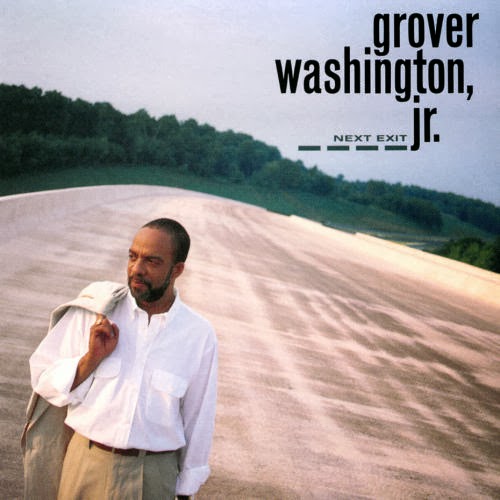
Review: Grover Washington Jnr - Next Exit

After an enviably strong and successful 1970’s that saw him creating his own distinctive brand of fusion jazz, as well as becoming a firm live and club favourite alongside his very handsome sales, Grover Washington Jr then hit the 80’s at full sprint with his ‘Winelight’ album. Refining his sound into something more lush and instantly appealing, but retaining his deep heart and soul, and laced with a rich and untoppable sense of melody, it went on to win an incredible amount of awards, as well as shift units by the ton load.

Unfortunately ‘Winelight’ also helped serve as a turn down a deadend for the great man, as he embarked on a long second phase career of trying to repeat that albums success, and slowly converting his soulful and funkily infectious fusion into what would firmly become known as smooth. ‘Come Morning’, his immediate follow-up to ‘Winelight’ was an alarmingly bland mood piece, that aimed for light and romantic but instead came up floaty and bland, sounding very polished but without possessing any real meat in the music.

After more than a decade of such similar affairs, ‘Next Exit’ in 1992 gets a slightly more contemporary boost, with some more of-the-moment production work, but essentially it’s still the same predictably standard fare of nice background music. Some mostly forgettable tunes are present, with Washington himself guilty of writing some of the largely indistinct and bloodless affairs, while Paul Desmonds classic ‘Take Five’ is also upsettingly dragged into the smooth mire.

As is typical of mostly everything Washington recorded from ‘Winelight’ onwards, he again brings in some musical friends to share the spotlight with him; this time including the special guests of legendary vocal quartet The Four Tops, and singers Nancy Wilson and Lalah Hathaway. All three are solid, though without being spectacular, whereas the numbers they perform on are essentially just a shameful waste of their great talents.

Enjoyable for the dedicated faithful of Washington’s soulful and heartfelt saxophone playing, and fans of other contemporary ‘light’ smooth music, it’s for everyone else wholly predictable and by-the-numbers. Undemanding background chill music, with absolutely no rough edges, it really won’t hold your attention, but neither will it offend the ears of any unsuspecting dinner guests for your evening soiree.

**

Tuesday, 25 February 2014

Review: Stan Getz & Joao Gilberto - The Best Of Two Worlds

More than a decade after their hugely successful collaboration classic ‘Getz/Gilberto’, tenor saxophone supremo Stan Getz and guitarist and genre creator Joao Gilberto decided in 1976 to re-unite and re-ignite the magic. Taking the winning combination of Antonio Carlos Join’s music and the musical arrangements of Oscar Carlos Neves, they were poised to conquer the world a second time.

Unfortunately for the duo, the musical world in the late-seventies was a vastly different one, with the current trends of more electric-based music in the form of disco, rock and fusion dominating. As such, on its initial release, the disc was completely over-looked and eventually largely forgotten. This though, even more unfortunately, is not some long-lost masterpiece worthy of re-evaluation and long overdue for good notices. It is instead a crushing disappointment.

Joining the two legends are a strong and eclectic band, including drummers Billy Hart and Grady Tate, bassist Steve Swallow, pianist Albert Dailey. Brazilian percussionists Airto, Ray Armando And Ruben Bassini also appear in order to add some samba colour to proceedings. Astrud Gilberto notably does not re-appear for vocal duties, largely in part due to her and Getz’s well-known affair, and so this befalls singer Heliosa Buarque de Hollanda, otherwise known as Miucha. Alongside the more than capable band, we get typically wonderful Jobim compositions such as ‘Waters Of March’ and ‘Falsa Bahiana’.

And yet, it’s a total mess. Getz, who should rightly be remembered as ‘The Sound’, possessing one of the most beautiful tones on any instrument, here is in a total slump. His sound is awful and bordering on the obnoxious, badly recorded and ultimately horrifically produced; for some reason the producer choosing to make Getz four times as loud as anybody else. Worse still is Miucha’s singing. Where Astrud Gilberto had under-sung, pretty much breathing her words, her style had fit the relaxed vibe perfectly. By strong contrast her replacement here decides some ‘free’ and off-key vocalising is the way forward. Not only does it not fit with Join’s music, but it just sounds terrible.

Ultimately, it’s the slap-dash feel that scuppers the record. With most tracks sounding under-rehearsed and most likely first takes, the afore-mentioned ‘Falsa Baiana’ cuts in loudly after a saxophone introduction and reeks of a tape cut-and-paste. ‘Eu Ven Da Bahia’ even ends with a voice clearly say “…felt good out there” before being cut off, enhancing the suspicions that whoever was behind this recording decided to do it in the quickest time possible, with minimal effort on making this a polished listening experience. All the more surprising given that this record bears the name of one of the worlds best producers and editors, Teo Macero.

Sub-par on every level, there are some relative ‘high’ points - ‘Ligia’ allows Gilberto full reign, his singing and guitar both top-rate, and the version of ‘Double Rainbow’ here being the clear highlight, benefitting from a really very good performance by Miucha. Ultimately whatever saving graces there are here, are due purely to Joao Gilberto - his beautiful guitar playing on ‘Joao Marcello’ contrasting sharply with the under-whelming poor form that Getz displays.

If you’re a fan of Bossa Nova, Getz or Gilberto, then you may be interested in this album, but truly it is the worst example of all three. ‘The Best Of Two Worlds’ was over-looked on its initial release, and frankly it’s best to leave it that way. Bearing the hallmarks of a poorly planned, badly executed and hurried recording, it’s one for die-hard collectors only, with just Gilberto stepping up, but even he is still marred by the lacklustre production. Apparently hating the results, Gilberto is best served anywhere else, and it is interesting to note that his 1973 watermark ‘Joao Gilberto’ actually contains many of the same songs here, and they are all undoubtedly of better quality. Similarly for Getz, this decade as a whole was just not a good one, whereas his work from the fifties, sixties and mid-to-late eighties is largely of the highest standard.

Most likely, given the animosity between them, recorded with Getz and Gilberto in separate studios, in as quick a time as possible, and spliced together at a later date (just as badly as the cover photos), it certainly sounds like it too. A disappointing missed opportunity, this really is one album that should be scrubbed from history.

**

Thursday, 6 February 2014

Review: Lou Donaldson - The Scorpion - Live At The Cadillac Club

For someone with the career of Lou Donaldson, spanning some fifty years and more than forty studio sessions as a bandleader, his live recordings are surprising thin on the ground. Worse still is the fact that those that do exist are disappointingly weak, the saddest and truest case in point being the oddly-titled ‘The Scorpion – Live At The Cadillac Club’.

Made up of extended funk and R&B grooves, the bulk of the music sounds nicely repetitve to shuffle along to in a club, but nothing really happens beyond the rhythms, which themselves start promisingly but quickly run out of puff. Guitarist Melvin Sparks, organist Leon Spencer and drummer Idris Muhammad keep the groove solid and tight, but even they aren’t able to hold it from simply becoming tired.

The little known Fred Ballard surprisingly emerges as a partial star here, possessing a bright tone and playing with enthusiastic abandon. His likeability however shows up his boss quite badly, with usual alto player Donaldson choosing during this time the baritone saxophone, which unfortunately gives him a completely indistinct sound and with a mostly hard to like harsh tone.

Nothing really occurs over the course of the record. Fans may notice the presence of Donaldson favourite ‘Aligator Bogaloo’ in the mix, but it’s not the cooking title track from the album of the same name; rather it’s an extended dragged out meander though the theme. The sound recording is good, but that’s only a minor saving grace in not only one of Lou Donaldson’s weakest outputs, but also his frankly his dullest.

**

Monday, 2 December 2013

Review: Jan Garbarek - Visible World

Following on from his excellent ‘Twelve Moons’ album, Jan Garbarek returns with the unique elemental sounding melancholia of which he seemingly has become both the master and sole student. Creating something perhaps slightly less austere than this earlier works, this is in fact due to a good deal of the music here being based on work for various previous soundtracks. As such it isn't really comparable to previous Garbarek works, as there doesn't exist a common theme or unifying thread, and that in turn creates the biggest problem with ‘Visible World’.

At times it falls somewhere between ambient and minimalism, a chilled and relaxing listening experience, heard best on the album highlight ‘Desolate Mountains’. At other times we get spirit-lifting euphoric tunes such as ‘Red Wind’ or ‘The Healing Smoke’. We also however get pieces that border dangerously close to being contemporary background and dinner party music, with ‘Survivor’ giving us at times something akin to ‘Panpipe Moods – Volume 4”.

For a recording, and recording artist, that seems focused on creating a mood – either one defined mood, or an evolving and developing set – there is quite a juxtaposition here that means you never quite settle in. It’s pleasant and at times even interesting, suitable for background music to some late evening soiree, but it never really hits a stride and gets going. There are a number of good pieces here for sure, but as good as they are, they never come together as a whole, feeling overall like a badly programmed chill compilation.

Occasionally Garbarek gets unfairly generalised as ‘new age’, as much a result of his more ethereal sounds and the lack of easy classification for his music to fall into, as it is the laziness of his commentators. Here though, although a qualified success, he has stepped almost willingly into the genre - albeit while keeping some of the euro-jazz spirit he is known for. For fans, there’s good music here, but with its soft nature and overall lack of cohesion it’s one of Garbareks less important and more unessential items.

**

Wednesday, 20 November 2013

Review: Grant Green - Easy

To say this is not Grant Green at his best would be a polite understatement. To say ‘Easy’ is perhaps a comment on Greens attitude to making this record would be nothing but entirely correct.

After a line of funkified jazz albums that had met with varying successes, Green again left Blue Note, his home for the most and best part of his career, and recorded for a number of different labels. Obviously aiming at a more commercial market the output was frequently less than stellar, and more often than not completely dire. This manages to fall into the latter camp. Hell, it practically owns it.

The seventies were often awash with jazz stars capitalising on the success and popularity of soul, rock and R&B, and Green himself had done very well mining this field with his ‘Caryin’ On’, ‘Visions’ and ‘Green Is Beautiful’ albums, not to mention a string of live albums. Here though Green is clearly not in charge, and the effect is obvious.

A huge band is the first problem, with Grant Green often at his best when working in small tight groups with every player able to crucially make their mark. Here instead we have a cast of thousands creating a distinctly unfunky funk gloop, with Green himself almost all but buried in the mix.

That’s not to say there aren’t great solos here. There are. And lots of them. You just won’t hear them unless you find some way of remixing the album yourself, such is the sheer number of instruments competing in their way. If you listen closely you can hear Green still close to his peak, playing with the technique and soul that you would expect. Why someone felt the need to suddenly add strings on top of him afterwards is a mystery only compounded further by the insult. Why bother having a star if he’s the one person you can’t hear?

‘Easy’ then is for the completist only. But even they’d be better off just ignoring it’s existence and accepting that Grant Green pretty much started and ended on Blue Note, with just a few small exceptioins. Remember him that way, not this.

**

Tuesday, 17 September 2013

Review: Diana Krall - Quiet Nights


It was always going to be just a matter of time before Diana Krall would make a bossa nova record. Moving on from her early piano trio days, her work has always moved towards the slower beat, and on ‘The Look Of Love’ she even hired arranger Claus Ogerman, who added a touch of bossa to proceedings.

So here it is; the ‘Diana Krall Does Bossa Nova’ album. But strangely for a bossa nova record, and even stranger given that the title of this recording is named after one of The Maestro’s more famous tunes, there is a surprisingly low number of songs here from Antonio Carlos Jobim. Instead we have three Jobim tunes mixed with a blend of songbook standards and ballads, performed in a bossa style.

‘Quiet Nights’ then is essentially the latest stage in the unjazzing of Diana Krall. Sure, there’s a hint of samba here and there, but mostly Krall operates in the slow and breathy whispery vocals that currently are bringing smiles to record label accountants everywhere with the likes of Melody Gardot and Norah Jones and their huge successes. Not that this would be too much of a problem when tackling bossa nova, but at times her voice becomes so breathy, it becomes lightweight and makes the songs sound simply tired. Worst of all, returning for his first time since ‘The Look Of Love’ Claus Ogerman again manages to cover everything in an anaemic glob.

The result is unpleasant at best. And certainly if you love anything bossa or Jobim related, I’d advise you to stop reading now and simply go and buy another copy of ‘Getz/Gilberto’ or check out anything by Eliane Elias.

‘The Girl From Ipanema’ is re-read in its boy version (always a bad start) and simply plods. Any tune or energy you’ve ever heard from this classic is replaced with sleepy drawling, the song being for some unfathomable reason being slowed down to half-speed as Krall wearily gasps the words out. ‘Quiet Nights’ too suffers the slowing down treatment, but at least retains its melody. Surprisingly, the third Jobim tune ‘Este Seu Olhar’ is actually pretty good, with a subtle arrangement and a silky vocal delivered in some very impassioned Portuguese.

Curiously the non-bossa tunes also suffer the plodding and crawling fate. Having successfully rendered ‘The Look Of Love’ completely uninteresting (a feat in itself) eight years before, attention is turned to another Bacharach/David classic in ‘Walk On By’ – which is then remade into a bloodless apology. ‘Everytime We Say Goodbye’ too is given perhaps its most non-descript treatment ever.

‘I’ve Grown Accustomed To His Face’ is one of two songs not done as a bossa number, but instead as a very slow ballad. And again, it’s the slowness that kills it. You’ll be willing for the pace to pick up just a little bit. The other song not in the bossa style is ‘Guess I’ll Hang My Tears Out To Dry’, and rather pleasingly it feels perfectly paced, with Anthony Wilsons silky and seductive guitar work raising it to an easy album highlight.

Intended as a ‘love letter for my husband’, it sounds more like a (over) production job than a personal and intimate dedication. Aiming for dreamy and sensuous gently swaying cocktail music, it instead – bossa or not – gives us a distinctly unsexy expensively made collection of songs that despite their high calibre, completely fail to engage. Not jazz, not bossa, it is a clutch of outstanding compositions from the background of both reduced to slow balladry, something that you would expect from someone of a much lesser pedigree than Diana Krall.

Obviously going for the romantic and caressing, Diana Kralls ‘Quiet Nights’ is more likely to instill drowsiness and instantly induce narcolepsy. So there you go, this is ‘Diana Krall Does Bossa Coma’.

**

Thursday, 17 January 2013

Review: John Coltrane - Om

I've listened to a lot of John Coltrane a lot of the time in the last 15 years. He produced a huge volume of work for someone whose solo career effectively ran for just a mere ten years, and played across so many different styles and changed his own sound so often and so suddenly that for many keeping up at the time was near impossible. Now with his entire recorded works easily available to any listener, nothing has changed, and his multiple different sounds can to many still be as alienating as they always had the potential to do. Case in point, my least favourite Coltrane, 'Om'...
Issued in 1965, Coltrane’s ‘Ascension’ was another stunning yet forceful, almost to the point of blunt trauma, innovation in his constantly accelerating career, that again gained solid critical notices – as well as for the nth time dividing fans who struggled to keep up. ‘Om’, recorded soon after in the same year, but suffering the fate of being delayed for release until a year after Coltrane’s death in ‘68, is more often than not set upon as being his worst album; an opinion which, even with the benefit of hindsight, is still very much agreed upon.


In truth, this negative opinion does stem from as much as being a genuinely lesser effort as it does from a poor comparison to the record (and records) that preceeded it, but it is not completely without its strengths. It does in truth fare very badly if taken with ‘Ascension’ as, despite the seemingly assault-like feeling of Coltrane and Pharaoh Sanders on that recording, there were some incredible contributions from many fine musicians, including the classic quartet members McCoy Tyner, Jimmy Garrison and Elvin Jones, as well as the swaggeringly muscular playing of Indianapolis golden boy Freddie Hubbard.

Here though the majority of the seven-piece band is near-utterly buried in the cacophony of competing noise, with the usually excellent Jones and his much-touted polyrhythmic sound swamped, and Tyner disappointingly not given any real space to shine at all – save one tiny piercing moment of light that manages to shine through. Garrison too doesn’t really get any time to himself, and frankly he is so anonymous here, it could really be anyone playing bass.

Similarly guest bass clarinetist Donald Rafael Garrett is clearly no Eric Dolphy (who passed away a year earlier in 1964) and doesn’t really offer anything of note, and Joe Brazil’s flute gives the recording some interesting colour, but ultimately does very little. Sometimes ‘Trane himself manages to break out from the sonic wall of noise and deliver some occasionally strong themes that sound reminiscent of his earlier and more obviously spiritual work – easily denouncing the unsubstantiated rumours that JC and the band were on LSD when this was recorded - but ultimately far too little.

‘Om’ sounds like a combined and forced expression of energy, but with all the energy all at once and without any particular guiding voice to lead or focus the chaos. Aiming for passion and emotional yearning, there is some music of note here, but the flow is disjointed and too much of an attempt at being ‘spiritual and in the moment’ leads instead to merely loud and unguided.

True, it probably shouldn’t have been one of the first posthumous releases, especially given the sheer quality of some of the sessions that came out over the next thirty years, but it doesn’t deserve quite the critical roasting it usually receives. Yes it opens and reveals smaller charms over its mere thirty minutes, and with repeated listens, but it really is only for the truly dedicated ‘Trane-heads or anyone academically studying the development of free-jazz. For anyone but the cult few though, the best moment really is going to be the moment it ends.

Hell, even the artwork is terrible.

**


Sunday, 6 January 2013

Review: John Coltrane - Live At The Village Vanguard & ...Again

This weekend has been one long John Coltrane mix playlist, and consequently a series of new reviews and some older re-edits. Some of my favourite listening has been with the live 'Trane releases, and so I've decided to post up a two-fer - 'Live At The Village Vanguard', and the later on '...Again'. Here goes.
----------

For four nights at the start of November in 1961, John Coltrane and his quartet famously played the Village Vanguard, with both some significant guest friends on stage, as well some decidedly unwelcome 'purist' critics in the audience. Aside from his usual group of pianist McCoy Tyner, bassist Jimmy Garrison and drummer Elvin Jones, alternating rhythm players Reggie Workman and Roy Haynes on bass and drums respectively also joined in, as did saxophonist and multi-reedsman Eric Dolphy, oboist Garvin Bushell and even famed oud man Ahmed Abdul-Malik. Together this grouping played something really quite special.

'Live At The Village Vanguard' then gives us three choice numbers from those four nights, with only nine different songs being played in various forms over the entirety of the bands short residency, and each of the band uniquely influencing the direction and sound of each piece. Indeed, the selected take on 'Spiritual', here as set opener, is impressive as much for its musical content as it is for its outstanding contributions from Bushell – a man who though never made a huge name for himself in the jazz field, worked with some of the fields greatest, including Fletcher Henderson, Gil Evans, Bunk Johnson, Fats Waller and Cab Calloway.

If anything though, the most notable presence here is that of oud Abdul-Malik (most famous perhaps for his tenure playing bass with Thelonious Monk, and with whom Abdul-Malik played in a quartet alongside Coltrane). Together they offer a distinct and strong middle-eastern sound that sits well with Coltrane's own leanings and stylings, and in fact shows another very different, and promising, potential future direction that the saxophonist might have taken, if given more time.

The big defining moment here however is the relatively stripped down ‘Chasin’ The Trane’ – so named by Coltrane’s engineer Rudy Van Gelder who literally had to chase ‘Trane around stage with a microphone due to his furious and highly mobile workout while playing. Effectively drawing battle-lines for critics and fans (not for the first time and certainly not for the last), here we have just bass and drums providing a steady pulse, with an intense blues blow-out from Coltrane that ultimately pushed boundaries a little too far for many tastes. ‘Chasin’’ lead to a series of near-damning reviews and articles, most of which Coltrane missed due to being out of the country and on tour in Europe. Upon returning he was stunned by what he read and heard and ultimately he and Eric Dolphy felt it necessary to reply to their critics in print. An undeniably powerful listen, it demands your attention, if only to hear what created such anger on its initial airing.

A nice live ‘sample’ document, at the time it surely served its purpose with aplomb, but it should however be noted that it has been easily supplanted by the four disc complete box set of all four sets recorded at the Vanguard. This set contains just a mere three tracks from an overall selection of twenty-two in total, and while many of those twenty-two are duplicate pieces, there is a huge difference in the way that they are played each and every time. The single disc then is the first port of call for the uninitiated, with the box set being there for those who want or crave more.

Impeccable music, with a strong spiritual and searching bent, its impact today may be somewhat less than it was in its original day, with 'Trane not for the last time splitting the critics, and even leading some notoriously to brand the album and its players as 'anti-jazz', but musically it has lost none of its power or charm, and along with 'Live At Birdland' should be heard at least once by any half-interested jazz fan.

*****

----------

After helping create a pantheon of greats that had released a 'Live At The Village Vanguard' album – Sonny Rollins and Bill Evans before him, and many more after - John Coltrane decided to repeat the success. This time though he decided to do it with his new 'free' quintet consisting of wife and pianist Alice Coltrane, long-timebassist Jimmy Garrison, drummer Rashied Ali, and both the man himself and Pharoah Sanders on tenor saxophone.

However whereas 'Trane and his classic quartet of McCoy Tyner, Garrison and Elvin Jones had famously previously struck gold, with both the single LP, and the later released complete concerts, '...Again' is a justifiably much less famous, and much lesser, effort.

Like the earlier release there are only three track selections here (albeit one is effectively an elongated intro) but the numbers here are as usual extended ruminations on more familiar recordings, in this case two of Coltrane's most famous pieces – his signature take on Rodgers & Hammersteins 'My Favourite Things' and his own 'Naima'.

Despite the potentially enticing presence of these undisputable classic greats though, the resulting music is distinctly disappointing. The main man is passionate and plays with great feeling – indeed his playing on both numbers is arguably his best – but where he lends the necessary beauty to his gorgeous ballad, Sanders screeches and screams his way over the top in an effort to be emotional, and instead ruins everything else going on.

Not that there is that much going on; besides Coltrane's own excellent playing, and Sanders over-blowing, the rest of the band appear to be distinctly 'off'. You'd never guess these were to-be-envied professionals, unless you were told of their names and past achievements, with the three players largely just walking and lightly vamping behind the frontline and rarely stepping forward.

For 'Trane die-hards then, this is great, showcasing as it does his immense skill and feel for the music, but ultimately its release is a mistake of quite vast proportions, with the band sounding flat and uninspired, and most listeners will simply just wish that a quartet missing Sanders had played that night. Really, this is only one for the dedicated fan, and anyone else would do well to give it a miss entirely.


**